Showing posts with label UNHCR. Show all posts

Monday, May 18, 2015

Message for Nepal


This is a video message from the Bhutanese refugee community in South Philadelphia who called Nepal home for over twenty years. They are concerned for their brothers and sisters who have been affected by the earthquakes. They are praying for the victims, survivors and families and for the rebuilding and restoration of Nepal. BuildaBridge assisted this community in creating artwork that illustrated their memories of Nepal, concerns for the earthquake victims and their hopes for the future of Nepal. Since many from this community are unable to travel to Nepal help, they created this video message as a gesture of their concern for and solidarity with those in Nepal.

The BuildaBridge-led workshops, artwork and video were made possible with support from:
The City of Philadelphia Mural Arts Program:  Southeast by Southeast
The Philadelphia Refugee Mental Health Collaborative
The Department of Behavioral Health and DisAbility Services
Artists:  Jessica LaBarca, Julie Rosen, Stevie French & Natalie Hoffmann
Individual financial donors:  Kristen and Monica

Thursday, May 14, 2015

The Nepal National Anthem


During the course of three workshops, BuildaBridge assisted this group of Bhutanese refugee adults create a visual representation of their memories, concerns and hopes for Nepal. During the close of each workshop, the group sang the Nepal national anthem featured here as a gesture of their solidarity and concern for Nepal. 

Tuesday, May 12, 2015

Responding to the Earthquake in Nepal

“When I am dreaming, I dream about Nepal and I wish I could go to help them” said a Bhutanese refugee in response to the earthquake.

Bhutanese refugees in South Philadelphia, many of whom spent twenty years in refugee camps in Nepal, are responding to the earthquakes through the healing power of art-making. The group's goal: To create prayer flags and paintings illustrating their fond memories of Nepal and hopes for Nepal's recovery and rebuilding.
BuildaBridge International is assisting the group, many of whom contributed to the PPR mural, with creating artwork that reflects the group's responses to three prompts: Nepal as you remember it (stories and memories); Nepal today (concerned, imagined struggles Nepalis are currently facing); and Nepal in the future (hopes, and prayers for the rebuilding).  The art piece being created consists of four bamboo poles, seven feet high, that are linked together.  In each of the three sections are canvas paintings responding to the three prompts.  Adorning each section above and below the canvases are prayer flags - the community's hopes and prayers for Nepal. 

”We would like to help with our hands [In Nepal] and want to do something; though we can’t help with our hands, we are glad to fundraise by sending money and a message.”  One Bhutanese woman exclaimed. This group is eager to send money and help in whatever ways they can.

Though tangible relief efforts are not possible from Philadelphia, this group wants to at least send their thoughts, messages and prayers to those suffering in Nepal.  "We hope", said another Bhutanese, "that Nepal is rebuilt and constructed better then before." 
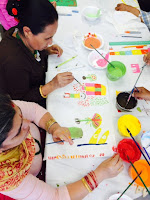
During the past week, the Bhutanese group was energetic, fully focused and engaged. They did not want to stop. In fact, they went 40 minutes over time -- twice.  Their artwork is bright, beautiful and hopeful with lots of trees and flowers. When asked if someone would like to lead a prayer for those in Nepal and this community suffering from afar to close class, they instead sang a song.  The group had a moment of silence and then almost all of them erupted into the song. This past Monday, our interpreter played the music for the Nepali anthem.  All twenty-one participants stood in a circle, hands clasped in a prayer stance at chest level, and sang along.  While there is much sadness and solidarity with those in Nepal, there is also hope as illustrated through this Bhutanese community's art and song.

In partnership with the Philadelphia Refugee Mental Health Collaborative, BuildaBridge is responding to the earthquakes by supporting and engaging the Bhutanese community in Philadelphia.

Thursday, March 19, 2015

Creative Arts Therapy as a means to Rebuild


“When there is peace, you can see it on the faces and in the eyes of children." A.K., a middle-aged man from Iraq, shared this quote about his drawing of children playing around trees.  A.K. noted during his sharing time that the music playing in the background, eased his nerves as he drew.  Read about A.K. here.

Oliver, a man in his young thirties, drew stick figures at an airport about to board a plane to a new land. In describing his image, he discussed his journey of leaving behind his home country and going to new country where he is currently unfamiliar with the language, people and the culture. Overwhelmed by these challenges, he shared with the group that he often thought “maybe I should go back home".  With encouragement from the group and much reflection through his artwork, he felt by the end that the group would be a good place to network and share his story as a survivor of torture.  

As part of BuildaBridge's efforts with the Philadelphia Partnership for Resilience, creative arts therapists and teaching artists provide art therapy and therapeutic art making groups in the community context for survivors of torture.  The stories of A.K. and Oliver signify the positive outcomes art can have in facilitating hope, healing and resiliency.  BuildaBridge uses creative arts therapy and the therapeutic arts because they are some of the most effective strategies for alleviating symptoms of trauma, abuse and stress through its effects on physiological, brain and hormonal activity. 

In honor of Creative Arts Therapy Week (#CATW2015), we share these stories of the transformative power of the arts through our work with survivors of torture, just one of many different vulnerable populations the organization serves through the arts.

Additionally, The United Nations High Commissioner for Refugees (UNHCR) affirms strategies like the ones BuildaBridge uses.  They note the use of Creative Arts Therapy with survivors of torture by describing Lembe's story.  "Lembe, a torture survivor, wrote her name on a colourful cloth. As part of her rehabilitation therapy, Lembe worked passionately on it, designing a fish, a bird and adding the names of other survivors. “Designing on the cloth helped my creativity,” she said “it allowed me to mentally relax, to learn how to express myself and to forget my daily hardships.”  Read Lembe's story and the UNHCR's article here on art therapy.

Tuesday, March 3, 2015

Does your art send a message?


"This piece reminds me of my village back in the Congo." 
"This painting of nature makes me feel calm."
"That's a portrait of Martin Luther King, Jr.!  I know who he is!"

Sunday February 22nd BuildaBridge artists and five clients of the Philadelphia Partnership for Resilience (PPR), a collaborative with Nationalities Services Center and Hebrew Immigrant Aid Society, visited the Philadelphia Museum of Art (PMA).  These trips, termed purposeful interventions, assist clients in learning about and engaging in American culture through arts and culture experiences outside of the classroom. In celebration of Black History Month, the group first viewed the exhibit “Represent:  200 Years of African American Art.”  "From compelling stories to innovative methods, Represent explores the evolving ways in which African American artists have expressed personal, political, and racial identity" (PMA).  Artists engaged clients in one-on-one conversations regarding the artwork, how it made them feel, what they thought the art meant, how it was related to events in their own lives and its significance during Black History Month.  Moving to the next exhibit, “Ink and Gold:  Art of the Kano”, large group discussions took place regarding the influence of China on Japanese art.  The fans in particular, each only 10 inches by 5 inches in size, illustrated a different story.  The intricate detail astounded and impressed us all.  One small group discussed the significance of community based on two pieces of artwork that illustrated Japanese villages.  This group reflected on components of communities in their countries of origin and compared it to their current communities in Philadelphia.  Another small group discussed the different elements of nature as depicted in three different paintings and how each painting made them feel.  In this exhibit, the museum provided drawing pads for attendees to attempt a sketch of the paintings.  One client spent a considerable amount of time sketching one nature scene and shared it with the larger group.  By the third exhibit, “American Art from the 18th Century”, clients were engaging other clients in conversations about the artwork, an accomplished outcome of these trips to create community and trusting relationships between clients.

In each of the exhibits, the artwork communicated messages of the artists, the culture of the artists and historical events.  Though conversations occurred between artists and clients and between clients, the real conversations occurred between the artwork and our group.  Our group listened to the messages of the artwork.  We reflected on them individually and collectively. We applied the messages to our own journeys, current situations and future hopes and dreams.

Similarly, Syrian refugees living in Jordan are trying to do the same thing - communicate with their communities and the world about their experiences.  Just as we listened to the artwork on display in a museum, so should we be listening to the crises in our world today through the messages from current artists and how we can make a difference. 

Friday, February 6, 2015

What's in a name?

S. wakes up every Sunday saying that it's the day for her art class. She looks forward to attending because her teacher knows her name and calls on her by name to lead dance movements.  S. had perfect attendance during the Fall of 2014 because BuildaBridge's art class made her feel important and valued.  

Julia Crawford, lead therapeutic movement instructor, greeting a child at the threshold

S. is one of 51.2 million displaced persons in the world today.  According to the United Nations High Commissioner for Refugees, this is the highest number since World World II and equivalent to the 26th largest nation on earth.

To S., the fact that her teacher knows her name is a huge reason why she attends BuildaBridge's art class.  Artists, teachers and creative arts therapists are trained in BuildaBridge's Classroom Model, a trauma-informed, hope-infused, child/client-centered approach that facilitates hope, healing and resiliency among populations experiencing crisis and poverty.  A large component of the trauma-informed method is affirmation of the individual, the culture from where they came and recognition of their abilities towards a hopeful future.  Artists learn each child's name as part of this affirmation process and call the child by name when welcoming them across the threshold, throughout the course of the class and when the child is leaving.   Learning one's name is the first step towards affirmation of the individual, becoming aware of their situation and taking action to make a difference.

BuildaBridge has taken that first step and gone beyond in providing programming as part of its Refugee Project serving 300 refugees, immigrants and survivors of torture  since 2011.

Imagine if we learned the names of all 51.2 million displaced persons in the world - we would be one step closer towards a brighter future for everyone.

To learn more about the conflicts that have caused displacement and how many have been displaced, check out the United Nations' The Refugee Project - an interactive map of refugee migrations around the world in each year since 1975. United Nations data is complemented by original histories of the major refugee crises of the last four decades, situated in their individual contexts.